

Seafood Market Projected to Reach USD 216.2 Billion by 2036 as Sustainable Aquaculture and "Blue Economy" Innovations
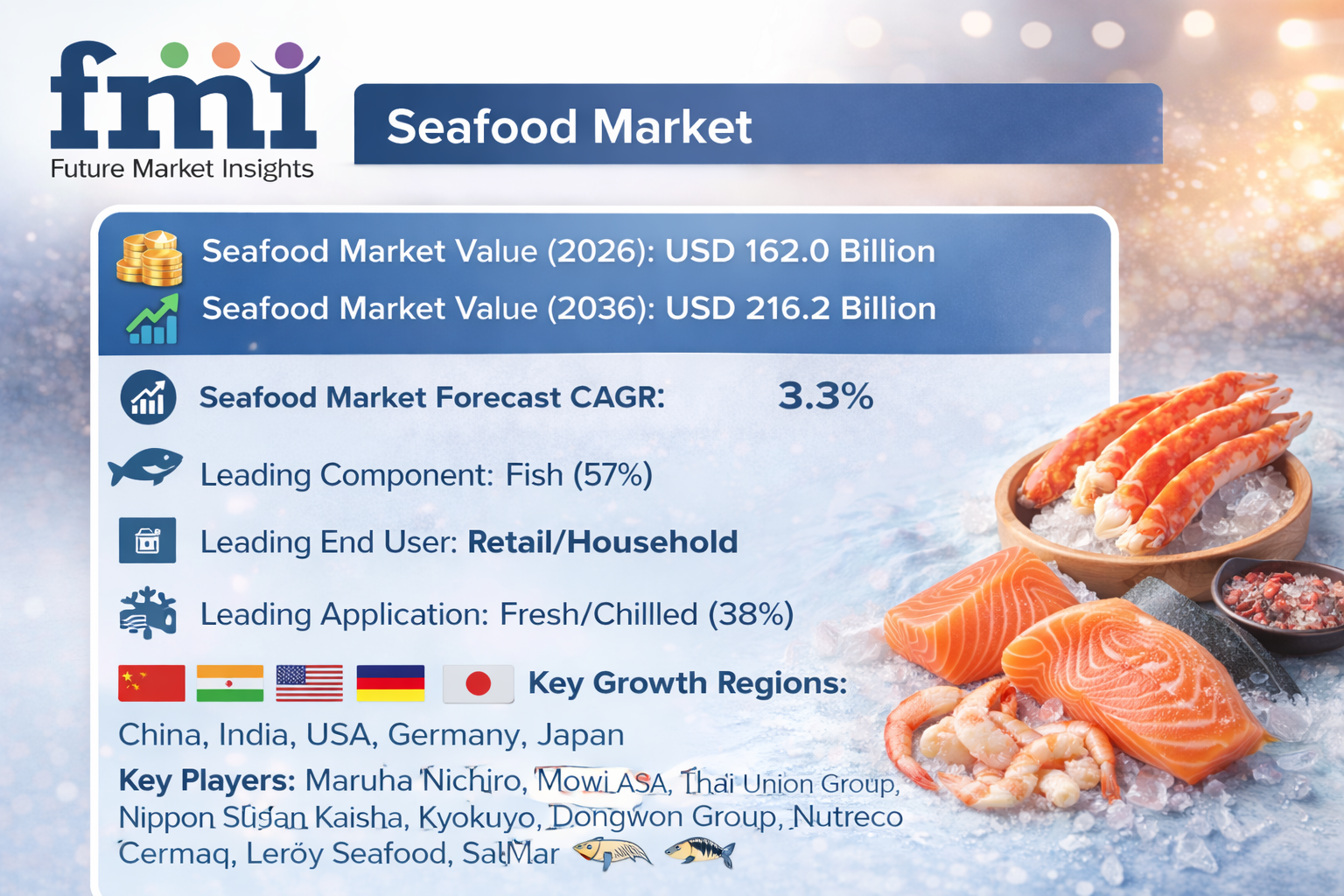
Seafood Market
Seafood Market Growth Driven by Sustainable Aquaculture Dominance, Precision Water-Quality Monitoring, and the Rise of Value-Added Functional Seafood
DELAWARE, NY, UNITED STATES, February 20, 2026 /EINPresswire.com/ -- The global seafood Market sector is evolving from a traditional wild-catch commodity market into a high-tech, vertically integrated component of the "Blue Economy," characterized by sustainable aquaculture expansion and regulatory-driven traceability. According to the latest strategic outlook by Future Market Insights (FMI), the global Seafood Market—valued at USD 162.0 billion in 2026—is projected to reach USD 216.2 billion by 2036, expanding at a CAGR of 3.3%.
The next decade will be defined by a historic shift in global food systems. In 2024, the FAO reported that aquaculture production (130.9 million tonnes) surpassed capture fisheries for the first time. As environmental scrutiny over overfishing intensifies, the industry is pivoting toward "smart" farming and blockchain-enabled traceability to ensure supply chain stability and consumer trust.
Quick Stats for Seafood Market
Market Value (2026): USD 162.0 Billion
Projected Market Value (2036): USD 216.2 Billion
Forecast CAGR (2026–2036):3%
Dominant Component: Fish (57% market share)
Leading End User Segment: Retail/Household Consumption
Top Application Segment: Fresh/Chilled Products (38% share)
Key High-Growth Countries: China, India, United States, Germany, Japan
👉 Get Access to the Report Sample: https://www.futuremarketinsights.com/reports/sample/rep-gb-14911
The Shift Toward Sustainable Stewardship and "Blue Food" Ecosystems
The seafood landscape is moving beyond basic harvesting. By 2026, the market is increasingly defined by "Ocean-to-Table" models, where the compatibility of production with ecosystem health is a primary purchase driver. Leading players like Thai Union Group and Mowi ASA are positioning for leadership through multi-million dollar sustainability initiatives, such as Thai Union’s SeaChange® 2030 strategy.
“Safeguarding the ocean is not just an environmental priority but a shared responsibility and a long-term investment in global resilience,” states Thiraphong Chansiri, CEO of Thai Union Group. This focus on stewardship is attracting institutional investors seeking sustainable yields in the burgeoning Blue Economy.
Segment Insights: Farm-Raised Dominance and the Versatility of Fish
The seafood category is segmented by source and product type, with demand increasingly shaped by the need for predictable harvest volumes and consistent sizing for retail contracts.
Farm-Raised (52% Share): Aquaculture remains the dominant source segment because it offers a controlled, scalable alternative to dwindling wild stocks. Advanced technologies in shrimp and salmon farming allow for high-density production with a reduced environmental footprint.
Fish (57% Share): This segment leads product-type demand as global staples like cod, tilapia, and salmon remain primary protein sources for billions. Innovation is focused on value-added formats, including pre-marinated fillets and surimi products that optimize the use of by-catch and trimmings.
Regional Polarization: Tech-Driven Frontiers vs. Massive Volume Markets
Regional dynamics reveal a focus on high-specification sustainability in the West and volume-driven efficiency in the East.
India (6.5% CAGR): Emerged as a seafood export powerhouse, modernizing its shrimp and frozen fish sectors to meet Western demand for traceable, high-quality exports.
Germany (6.0% CAGR): Leading the transition to certified sustainable consumption, where eco-labels like MSC are a non-negotiable prerequisite for market entry.
United States (5.7% CAGR): Driven by a health-conscious consumer base and a surge in domestic aquaculture aimed at reducing reliance on imports, which currently comprise over 50% of the market.
China (4.2% CAGR): Remains the global heavyweight, aggressively promoting deep-sea aquaculture to overcome freshwater resource constraints.
Key Market Stats (2026–2036)
Industrializing Performance: The Competitive Landscape
Competitive advantage in the seafood market is now measured by vertical integration and carbon footprint reduction. Maruha Nichiro, Nippon Suisan Kaisha, and Dongwon Group are leveraging end-to-end processing and branding to secure margins. As urban lifestyles become busier, these giants are pivoting toward ready-to-eat kits and functional seafood fortified with additional nutrients to appeal to the modern, health-conscious consumer.
FAQs
What factors are driving growth in the global Seafood market?
Rising health awareness, growing demand for omega-3 rich diets, expanding cold chain infrastructure, and increasing penetration of organized retail channels are key growth drivers.
Which regions are expected to witness the fastest growth in the Seafood market?
Asia Pacific is anticipated to lead growth due to strong aquaculture expansion, rising disposable incomes, and increasing seafood consumption in coastal and urban populations.
How is sustainability influencing the Seafood market landscape?
Sustainability certifications, responsible fishing practices, and traceability requirements are reshaping procurement strategies and influencing consumer purchasing decisions globally.
What role does aquaculture play in market expansion?
Aquaculture continues to offset pressure on wild catch fisheries, ensuring consistent supply and supporting long-term market stability.
Related Reports:
Canned Seafood Market: https://www.futuremarketinsights.com/reports/canned-seafood-market
Frozen Seafood Market: https://www.futuremarketinsights.com/reports/frozen-seafood-market
Sustainable Seafood Market: https://www.futuremarketinsights.com/reports/sustainable-seafood-market
Feed Enzymes Market : https://www.futuremarketinsights.com/reports/feed-enzymes-market
Meat Enzymes Market : https://www.futuremarketinsights.com/reports/meat-enzymes-market
About Future Market Insights (FMI)
Future Market Insights, Inc. (FMI) is an ESOMAR-certified, ISO 9001:2015 market research and consulting organization, trusted by Fortune 500 clients and global enterprises. With operations in the U.S., UK, India, and Dubai, FMI provides data-backed insights and strategic intelligence across 30+ industries and 1200 markets worldwide.
Contact Us:
Future Market Insights Inc.
Christiana Corporate, 200 Continental Drive,
Suite 401, Newark, Delaware - 19713, USA
T: +1-347-918-3531
For Sales Enquiries: sales@futuremarketinsights.com
Sudip Saha
Future Market Insights Inc.
+ +1 347-918-3531
email us here
Legal Disclaimer:
EIN Presswire provides this news content "as is" without warranty of any kind. We do not accept any responsibility or liability for the accuracy, content, images, videos, licenses, completeness, legality, or reliability of the information contained in this article. If you have any complaints or copyright issues related to this article, kindly contact the author above.
