

Global Business Analytics Market Set to Reach USD 176.14 Billion by 2032, Driven by AI Integration, Real-Time Insights, and Data-Driven Decision Making: - Verified Market Research
Driven by exponential data generation, rapid cloud adoption, and the integration of AI-powered augmented analytics, the Global Business Analytics Market is transforming into a real-time, decision intelligence ecosystem enabling predictive, prescriptive, and autonomous enterprise strategies across industries.
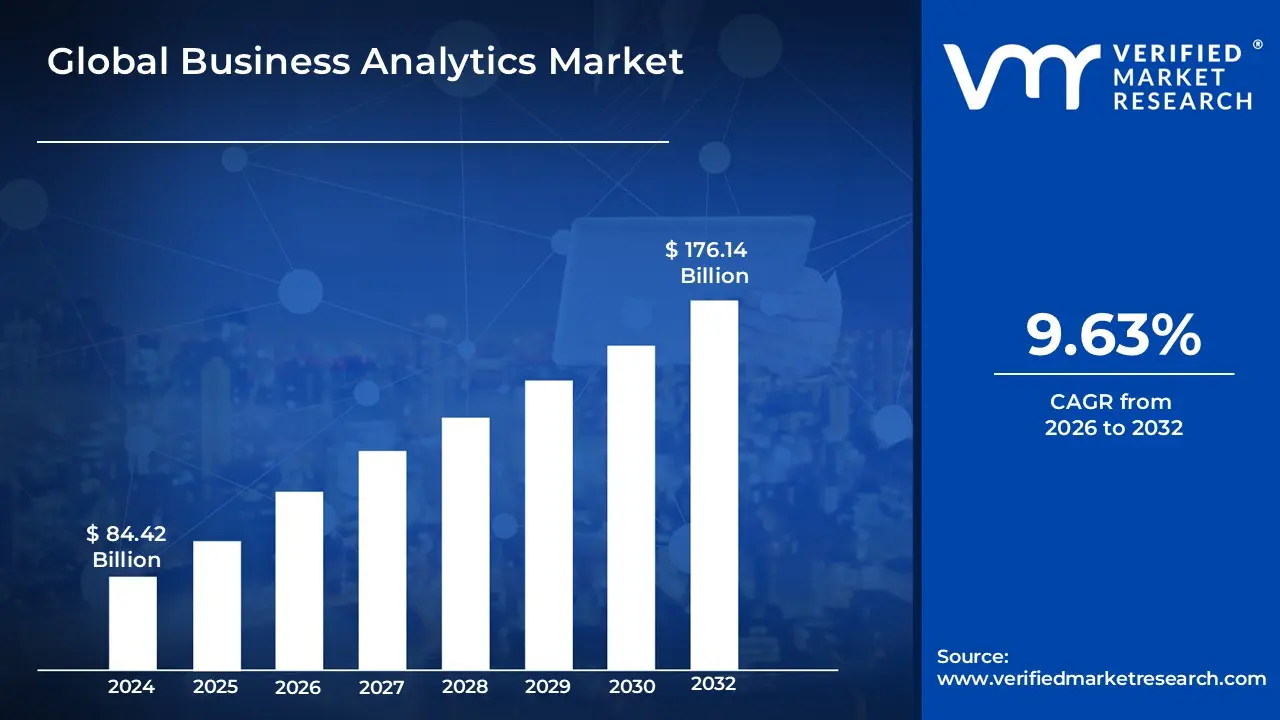
Lewes, Delaware, April 30, 2026 (GLOBE NEWSWIRE) -- The Global Business Analytics Market is experiencing a transformative phase, with its market size valued at USD 84.42 Billion in 2024 and projected to reach USD 176.14 Billion by 2032, growing at a CAGR of 9.63% from 2026 to 2032, according to the latest analysis by Verified Market Research. The rapid integration of Artificial Intelligence (AI), machine learning, and augmented analytics is reshaping how enterprises leverage data to make forward-looking, strategic decisions.
Download a free sample to access exclusive Insights, Data Charts, And Forecasts From The Business Analytics Market Sample Report.
Market Overview
The Business Analytics Market represents a critical evolution in enterprise intelligence, shifting from retrospective reporting toward predictive and prescriptive decision-making frameworks. Unlike traditional business intelligence systems that primarily answer “what happened,” modern business analytics focuses on answering “what will happen” and “what should be done.”
This market encompasses a wide range of solutions, including:
- Software platforms (cloud-based and on-premise)
- Professional and managed services
- Data mining and predictive modeling tools
- Machine learning-powered analytics systems
The Global Business Analytics Market operates across four foundational analytical pillars:
- Descriptive Analytics – Understanding historical data
- Diagnostic Analytics – Identifying root causes
- Predictive Analytics – Forecasting future outcomes
- Prescriptive Analytics – Recommending actionable strategies
By 2026, the market is increasingly defined by AI-driven automation, where systems proactively detect anomalies, generate insights, and recommend actions without human intervention. The growing reliance on analytics across industries highlights its role as a strategic asset for enterprise transformation.
Key Growth Drivers
Explosion of Data Volume
The exponential increase in global data is one of the most powerful drivers of Business Analytics Market Growth. With the proliferation of IoT devices, 5G connectivity, and digital transactions, organizations are managing unprecedented volumes of structured and unstructured data.
This data deluge necessitates advanced analytics platforms capable of:
- Processing large-scale datasets
- Cleaning and structuring raw information
- Extracting actionable insights
Organizations that effectively leverage this data gain a significant competitive advantage, positioning analytics as a core business necessity rather than a supporting tool.
Shift Toward Data-Driven Decision Making
The transition from intuition-based decision-making to evidence-based strategies is accelerating. Enterprises are adopting Decision Intelligence platforms that provide quantifiable insights for strategic planning.
This trend is particularly critical in:
- BFSI – where risk assessment and fraud detection are essential
- Healthcare – where decisions directly impact patient outcomes
Analytics reduces uncertainty, enabling organizations to simulate multiple scenarios before execution.
Digital Transformation Across Industries
Digital transformation has become a baseline requirement for competitiveness. As industries digitize operations, analytics acts as the connective layer that integrates data across departments.
Key developments include:
- Smart supply chains
- Digital twins
- Real-time operational monitoring
This transformation enables a glass-box enterprise model, offering complete visibility into operations.
Growing Adoption of Cloud-Based Solutions
Cloud computing is revolutionizing the Global Business Analytics Market by lowering entry barriers and enabling scalability.
Key benefits include:
- Reduced capital expenditure
- Elastic computing power
- Accessibility for SMEs
By 2026, over 65% of organizations have transitioned analytics workloads to the cloud, accelerating market expansion and democratizing access to advanced analytics capabilities.
Rising Demand for Real-Time Insights
Modern businesses require instant decision-making capabilities, making real-time analytics indispensable.
Applications include:
- Dynamic pricing in e-commerce
- Fraud detection in fintech
- Real-time patient monitoring
Organizations leveraging real-time analytics are significantly faster in decision-making, making speed a critical competitive differentiator.
Focus on Customer Experience and Personalization
Hyper-personalization has become a key competitive strategy. Businesses use analytics to understand customer behavior at an individual level, enabling:
- Targeted marketing campaigns
- Predictive recommendations
- Enhanced customer engagement
This shift toward Segment of One strategies is driving demand for advanced analytics tools.
Regulatory and Compliance Requirements
Evolving regulations are increasing the importance of analytics in ensuring compliance. Businesses use analytics to:
- Maintain data transparency
- Detect bias in AI models
- Automate ESG reporting
Compliance-driven analytics is emerging as a rapidly growing segment within the market.
Integration of Advanced Technologies
The convergence of AI, machine learning, and natural language processing is transforming the Business Analytics Industry into a more accessible and powerful ecosystem.
Augmented analytics enables:
- Natural language queries
- Automated insight generation
- Broader adoption among non-technical users
This trend is accelerating the rise of citizen data scientists.
Competitive Pressure and Cost Optimization
Organizations are investing in analytics to:
- Optimize operations
- Reduce costs
- Maintain competitive advantage
Analytics-driven strategies such as predictive maintenance can significantly reduce operational expenses, reinforcing its value as a profitability tool.
Download a free sample to access exclusive Insights, Data Charts, And Forecasts From The Business Analytics Market Sample Report.
Market Challenges and Restraints
While the Global Business Analytics Market demonstrates strong growth momentum, several structural and operational constraints continue to act as friction points, slowing full-scale adoption and scalability across industries.
High Implementation and Total Cost of Ownership
One of the most critical barriers within the Business Analytics Market is the substantial financial investment required to deploy and maintain advanced analytics ecosystems. Organizations must not only invest in software licensing but also allocate significant capital towards,
- High-performance computing infrastructure
- Scalable cloud storage environments
- Integration of edge computing systems
- Continuous system upgrades and maintenance
For many small and medium-sized enterprises (SMEs), this creates a dual burden of capital expenditure (CAPEX) and operational expenditure (OPEX). Even when cloud solutions reduce upfront costs, ongoing subscription models, data storage fees, and AI processing costs accumulate over time. As a result, many organizations opt for limited or lite analytics implementations that lack full predictive and prescriptive capabilities, thereby constraining the broader Business Analytics Market Growth.
Persistent Data Quality and Integration Challenges
The effectiveness of analytics systems is fundamentally dependent on data integrity. However, many enterprises continue to struggle with fragmented data ecosystems where critical information remains siloed across legacy systems.
Key issues include:
- Inconsistent data formats across departments
- Duplication of records
- Lack of standardized data governance frameworks
- Manual data cleansing requirements
The principle of “Garbage In, Garbage Out” remains highly relevant in 2026. Even the most advanced AI-driven analytics platforms cannot compensate for poor data quality. This results in:
- Reduced trust in analytics outputs
- Delayed project timelines
- Inaccurate forecasting and decision-making
The inability to seamlessly integrate data across systems continues to limit the realization of full analytical value.
Global Shortage of Skilled Analytics Professionals
A significant restraint impacting the Business Analytics Industry is the shortage of professionals with the required hybrid skill sets. Organizations require individuals who can:
- Develop and manage machine learning models
- Interpret analytical outputs
- Translate insights into strategic business actions
However, the supply of such talent remains limited. This High Demand-Low Supply imbalance has several consequences:
- Increased hiring and retention costs
- Dependence on external consultants
- Delays in analytics implementation
This talent gap is particularly pronounced in emerging markets, where digital transformation is accelerating faster than workforce development.
Security and Privacy Concerns
As organizations handle increasing volumes of sensitive data, security risks have become a major concern. The growing adoption of cloud-based analytics introduces additional vulnerabilities, including:
- Data breaches
- Unauthorized access
- Data leakage into AI systems
The financial and reputational impact of such incidents is substantial, with average breach costs reaching significant levels. Consequently, organizations are forced to invest heavily in:
- Encryption technologies
- Privacy-preserving analytics
- Secure data governance frameworks
While these measures enhance security, they often slow down analytics deployment and reduce operational agility.
Technical Complexity of Advanced Analytics Systems
Despite advancements in low-code and no-code platforms, the underlying architecture of modern analytics systems remains highly complex. Organizations must manage:
- Event-driven architectures
- Real-time data streaming pipelines
- Distributed data models
This complexity leads to:
- Low user adoption among non-technical staff
- Underutilization of analytics tools
- Increased reliance on specialized IT teams
Many organizations find themselves over-tooled, possessing sophisticated platforms without the internal capability to fully leverage them.
Organizational Resistance and Cultural Barriers
Analytics adoption is not purely a technological challenge it is also a cultural transformation. Resistance often arises from:
- Fear of job displacement due to automation
- Preference for traditional decision-making methods
- Lack of data literacy among employees
Without strong leadership and change management strategies, organizations may fail to achieve meaningful ROI from analytics investments.
Regulatory Complexity and Compliance Burden
The global regulatory environment continues to evolve rapidly, with increasing emphasis on:
- Data privacy
- AI transparency
- Ethical use of data
Organizations must ensure compliance with multiple regional regulations, requiring:
- Detailed data lineage tracking
- Model explainability
- Continuous auditing processes
These requirements add complexity and cost, diverting resources from innovation.
Challenges in Measuring ROI
Unlike traditional investments, analytics delivers both tangible and intangible benefits. While cost savings and efficiency improvements are measurable, benefits such as:
- Faster decision-making
- Improved risk mitigation
- Enhanced customer experience
are more difficult to quantify. This creates skepticism among financial decision-makers, leading to delayed or reduced investment in analytics initiatives.
Infrastructure Limitations
Legacy IT systems continue to hinder the adoption of modern analytics solutions. Many organizations lack the necessary infrastructure to support:
- Real-time analytics
- AI-driven processing
- Large-scale data storage
As a result, significant investment is required to upgrade infrastructure before analytics can be effectively deployed.
Interoperability Issues Across Systems
The lack of seamless integration between analytics platforms and existing enterprise systems creates inconsistencies in data interpretation. This results in:
- Conflicting reports across departments
- Manual reconciliation efforts
- Reduced operational efficiency
Interoperability remains a critical challenge that must be addressed to unlock the full potential of the Global Business Analytics Market.
Download a free sample to access exclusive Insights, Data Charts, And Forecasts From The Business Analytics Market Sample Report.
Technology and Innovation Trends
The Business Analytics Market is evolving rapidly, driven by continuous technological innovation that enhances both capability and accessibility.
Augmented Analytics and AI Integration
Augmented analytics represents a major shift toward automation, where AI and machine learning are embedded within analytics platforms to:
- Automatically identify patterns
- Generate insights
- Recommend actions
This reduces reliance on manual analysis and accelerates decision-making processes.
Rise of Agentic AI and Autonomous Decision Systems
A defining trend in 2026 is the emergence of agentic AI, where analytics systems act autonomously to:
- Monitor data streams
- Detect anomalies
- Trigger responses without human intervention
This evolution transforms analytics from a passive tool into an active decision-making engine.
Natural Language Processing (NLP) for Data Accessibility
NLP is making analytics more accessible by enabling users to interact with data using simple language. This eliminates technical barriers and allows non-specialists to:
- Query data
- Generate reports
- Interpret insights
This trend is accelerating the adoption of analytics across all organizational levels.
Real-Time Streaming and Edge Analytics
The demand for real-time insights is driving the adoption of streaming analytics and edge computing. These technologies enable:
- Instant data processing
- Low-latency decision-making
- On-device analytics for IoT applications
This is particularly important in sectors such as manufacturing, healthcare, and finance.
Serverless and Cloud-Native Architectures
Cloud-native and serverless architectures are becoming the standard for analytics deployment. These models provide:
- Scalability
- Cost efficiency
- Flexibility
They also support the growing demand for Analytics-as-a-Service (AaaS) models.
Explainable AI (XAI) and Ethical Analytics
As AI adoption increases, there is a growing focus on transparency and accountability. Explainable AI ensures that:
- Decisions can be understood and justified
- Bias is minimized
- Compliance requirements are met
This trend is particularly important in regulated industries.
Download a free sample to access exclusive Insights, Data Charts, And Forecasts From The Business Analytics Market Sample Report.
Market Segmentation Analysis
The Business Analytics Market Segmentation highlights the structural composition of the industry and provides insights into key growth areas.
By Component: Software vs. Services
The software segment dominates, accounting for approximately 64.7% of global revenue in 2026. This dominance is driven by:
- Widespread adoption of cloud-based analytics platforms
- Increased demand for self-service BI tools
- Integration of AI and automation features
Software platforms serve as the backbone of analytics ecosystems, enabling organizations to centralize and process data efficiently.
The services segment, while smaller in share, is experiencing strong growth due to:
- Increasing system complexity
- Need for expert implementation
- Demand for managed analytics services
Services play a critical role in bridging the skills gap and ensuring successful deployment of analytics solutions.
By Deployment Mode: Cloud-Based vs. On-Premise
The cloud-based segment leads the market, accounting for approximately 70.5% of revenue. This dominance is attributed to:
- Scalability and flexibility
- Lower upfront costs
- Support for remote and hybrid work environments
Cloud deployment enables organizations to handle massive data volumes without investing in physical infrastructure.
The on-premise segment remains relevant for organizations requiring:
- High data security
- Compliance with data residency regulations
- Low-latency performance
Hybrid models are emerging as a strategic solution, combining the benefits of both approaches.
By Organization Size
Large enterprises dominate the market with a 61.7% share, driven by their ability to invest in advanced analytics infrastructure and technologies.
Key factors include:
- Complex operational requirements
- Regulatory compliance needs
- Large-scale data management
SMEs, however, represent the fastest-growing segment, driven by:
- Cloud adoption
- Low-code analytics tools
- Increasing digitalization
This segment is expected to play a significant role in future market expansion.
By Application
Finance analytics leads the market with over 28% share, driven by:
- Fraud detection
- Risk management
- Regulatory compliance
Marketing analytics is the fastest-growing segment, fueled by:
- Demand for personalization
- Growth of digital marketing
- Expansion of e-commerce
Other applications such as supply chain analytics and data mining support operational efficiency and strategic planning.
By End-User Industry
The BFSI sector remains the dominant end user, accounting for approximately 18.15% of market share. This is due to:
- High reliance on data-driven decision-making
- Regulatory requirements
- Need for risk management
Other key industries include:
- Retail & E-commerce
- Healthcare
- Manufacturing
- Energy & Utilities
Each sector leverages analytics to improve efficiency, reduce costs, and enhance decision-making.
By Geography
- North America – Largest market with strong technological infrastructure
- Europe – Leader in compliance-driven analytics
- Asia-Pacific – Fastest-growing region with rapid digital transformation
- Latin America – Growth driven by e-commerce and risk management
-
Middle East & Africa – Expansion driven by smart city initiatives
Competitive Landscape
The Business Analytics Industry is highly competitive, with major players focusing on innovation, partnerships, and AI integration. Key companies include:
- IBM
- Microsoft
- Oracle
- SAP
- SAS Institute
- Tableau
- Amazon Web Services
- Google Cloud Platform
- Microsoft Azure
- Salesforce Einstein Analytics
- Qlik
- MicroStrategy
- Tibco Software
- Informatica
- Alteryx
- ThoughtSpot
- Looker
- Domo
- Sisense
These companies are investing heavily in AI, cloud computing, and real-time analytics to maintain market leadership.
Strategic Outlook Through Forecast Year
The Business Analytics Market Forecast indicates sustained growth driven by:
- AI-native analytics platforms
- Real-time decision intelligence
- Cloud-based scalability
- Increasing enterprise reliance on data
As organizations continue to prioritize efficiency, innovation, and competitiveness, business analytics will evolve into a central intelligence layer powering enterprise ecosystems.
The shift toward autonomous, agent-driven analytics systems will redefine how decisions are made, enabling organizations to move from reactive strategies to proactive, predictive, and prescriptive operations.
Related Reports
Global Advanced Analytics Market Size by Type (Big Data Analytics, Business Analytics, Customer Analytics, Risk Analytics), Deployment Mode (On-premises, Cloud), Organization Size (Large Enterprises, SMEs), Industry Vertical (Banking, Financial Services, and Insurance (BFSI), Telecommunications and IT, Healthcare and Life Sciences, Government & Defense) & Region for 2024-2031
Global Cloud Computing Platform As A Service (PAAS) Market Size By Deployment Type (Public Cloud, Private Cloud, Hybrid Cloud), By Application (Development & Testing, Data Management, Integration & Middleware, Business Analytics), By End-User Industry (IT & Telecom, BFSI, Healthcare, Retail, Manufacturing), By Geographic Scope And Forecast
Global SaaS-based Business Analytics Market Size By Type (On-site and Cloud), By Enterprise (Large Enterprises and SMEs), By Application (BFSI, Retail and E-commerce, Manufacturing, Telecom and IT), By Geographic Scope And Forecast
Global BPO Business Analytics Market Size By Service Type, By Deployment Model, By Application, By Geographic Scope And Forecast
Top SaaS-Based Business Analytics Solutions: Leading SaaS Business Intelligence Software and Data Analytics Platforms
Visualize Business Analytics Market using Verified Market Intelligence -:
Verified Market Intelligence is our BI Enabled Platform for narrative storytelling in this market. VMI offers in-depth forecasted trends and accurate Insights on over 20,000+ emerging & niche markets, helping you make critical revenue-impacting decisions for a brilliant future.
VMI provides a holistic overview and global competitive landscape with respect to Region, Country, Segment, and Key players of your market. Present your Market Report & findings with an inbuilt presentation feature saving over 70% of your time and resources for Investor, Sales & Marketing, R&D, and Product Development pitches. VMI enables data delivery In Excel and Interactive PDF formats with over 15+ Key Market Indicators for your market.
About Us
Verified Market Research® stands at the forefront as a global leader in Research and Consulting, offering unparalleled analytical research solutions that empower organizations with the insights needed for critical business decisions. Celebrating 10+ years of service, VMR has been instrumental in providing founders and companies with precise, up-to-date research data.
With a team of 500+ Analysts and subject matter experts, VMR leverages internationally recognized research methodologies for data collection and analyses, covering over 15,000 high impact and niche markets. This robust team ensures data integrity and offers insights that are both informative and actionable, tailored to the strategic needs of businesses across various industries.
VMR's domain expertise is recognized across 14 key industries, including Semiconductor & Electronics, Healthcare & Pharmaceuticals, Energy, Technology, Automobiles, Defense, Mining, Manufacturing, Retail, and Agriculture & Food. In-depth market analysis cover over 52 countries, with advanced data collection methods and sophisticated research techniques being utilized. This approach allows for actionable insights to be furnished by seasoned analysts, equipping clients with the essential knowledge necessary for critical revenue decisions across these varied and vital industries.
Verified Market Research® is also a member of ESOMAR, an organization renowned for setting the benchmark in ethical and professional standards in market research. This affiliation highlights VMR's dedication to conducting research with integrity and reliability, ensuring that the insights offered are not only valuable but also ethically sourced and respected worldwide.
Follow Us On: LinkedIn | Twitter | Threads | Instagram | Facebook

Contact Us

Mr. Edwyne Fernandes

Verified Market Research®

US: +1 (650)-781-4080

US Toll Free: +1 (800)-782-1768

Email: sales@verifiedmarketresearch.com

Web: https://www.verifiedmarketresearch.com/

SOURCE – Verified Market Research®

Legal Disclaimer:
EIN Presswire provides this news content "as is" without warranty of any kind. We do not accept any responsibility or liability for the accuracy, content, images, videos, licenses, completeness, legality, or reliability of the information contained in this article. If you have any complaints or copyright issues related to this article, kindly contact the author above.
